Kenya’s agricultural sector this week highlighted the critical role of infrastructure, trade competitiveness, and strategic investment in sustaining growth. From efforts to unlock large-scale irrigation in Tana River to growing concerns over flower export costs, stakeholders continued to emphasize the need for stronger systems that support productivity, market access, and long-term sector resilience.
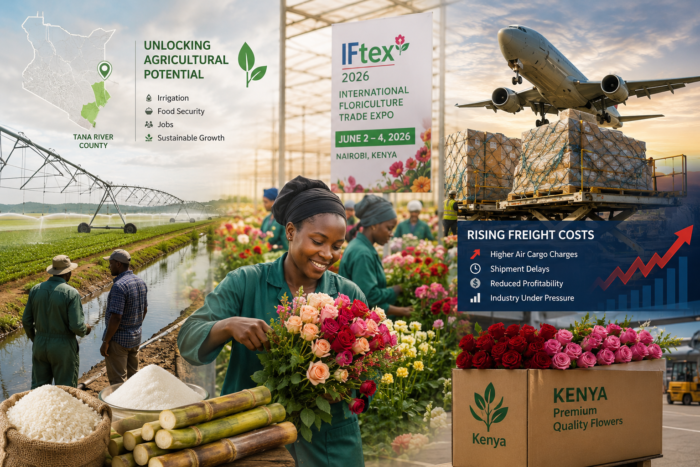
Food Security & Irrigation: Government Moves to Unlock Tana River’s Agricultural Potential
President William Ruto has attributed delays in major irrigation projects in Tana River County to persistent leadership disputes and unresolved land ownership issues. The projects, which include large-scale rice and sugar production schemes, form a key part of the government’s strategy to strengthen food security, create jobs, and reduce reliance on imported food commodities.
The President noted that despite the county’s abundant water resources and fertile land, development has been slowed by land adjudication challenges and absentee landlord disputes. To accelerate implementation, the government plans to compensate absentee landowners and issue title deeds to squatters occupying the affected land. Officials believe resolving these long-standing issues could unlock significant agricultural investment and transform Tana River into one of Kenya’s leading food production zones.
Trade & Market Expansion: Nairobi Hosts Global Floriculture Industry
Kenya’s position as a global floriculture powerhouse will be on display as international stakeholders gather in Nairobi for IFTEX 2026. The expo is expected to attract a record number of exhibitors and participants from major flower-producing and importing markets across Europe, Asia, Africa, and the Middle East.
Industry leaders view the event as an important platform for strengthening trade partnerships, exploring innovation, and expanding market opportunities. As one of Kenya’s top foreign exchange earners, the floriculture sector continues to play a vital role in supporting employment and export growth. Organisers also expect the event to showcase advances in sustainable production, technology adoption, and supply chain development across the industry.
Export Competitiveness: Rising Freight Costs Pressure Flower Growers
Despite strong international demand, Kenya’s flower export industry is facing increasing pressure from rising freight costs. Exporters report that air cargo charges have climbed sharply due to global supply chain disruptions, geopolitical tensions, and limited cargo capacity, significantly increasing the cost of accessing key markets.
Industry stakeholders warn that higher logistics expenses are squeezing margins, causing shipment delays, and increasing the risk of product losses. The challenge is particularly significant for cut flowers, which rely on fast and reliable transportation to maintain quality. Sector players are now calling for measures to improve cargo efficiency and reduce export costs, warning that Kenya could lose market share if competitiveness continues to decline.
Market Takeaway
This week’s developments underscore the importance of infrastructure and logistics in determining agricultural success. While irrigation investments could unlock new production frontiers and strengthen food security, export-oriented industries such as floriculture remain vulnerable to rising transport costs. Sustained growth will depend on Kenya’s ability to improve both production capacity and market competitiveness across its agricultural value chains.
References
- Capital FM — President Ruto blames local leadership wrangles for delayed irrigation projects in Tana River (May 2026)
- Kilimo News — Global flower traders converge in Nairobi for IFTEX 2026 amid industry expansion (May 28, 2026)
- The Standard — Kenya’s flower exports feel the heat of rising freight costs (May 28, 2026)